
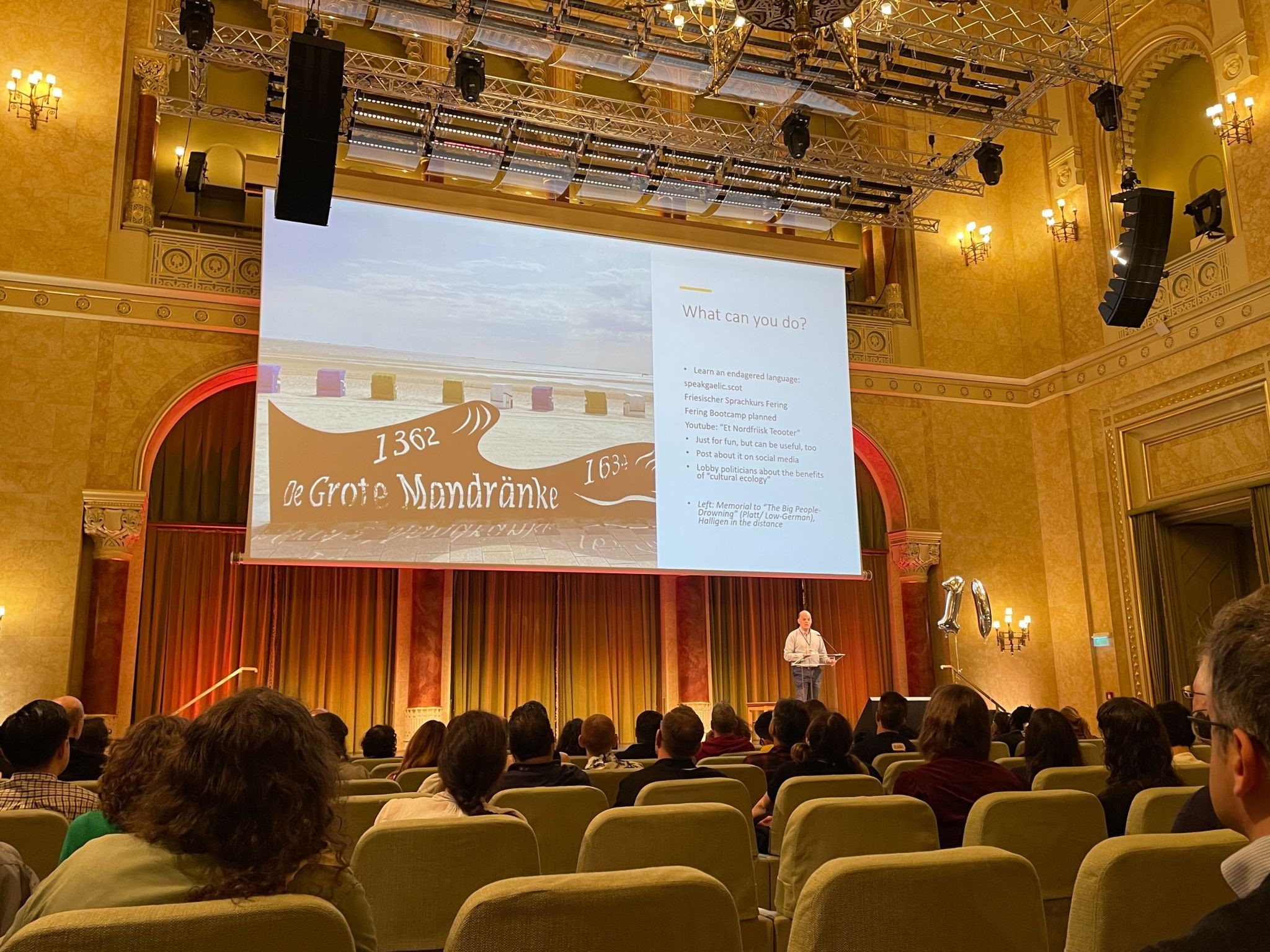
Some key messages from my recent talk at the Polyglot Conference in Budapest:
- Recent research found that 90% of young adults in the Outer Hebrides of Scotland support the Gaelic language (good to know given some of the bad vibes on social media).
- Even though the local authority recently took the progressive step of making Gaelic Medium education the default, this is still not sufficient to create active speakers. I have interviewed pupils at the end of their primary school career who are unable to correctly say in Gaelic: “My name is…”. This means more opportunities need to be created to use the language outside of school.
- Ideally intergenerational transmission should be encouraged. Prospective parents need to be made aware that they should learn the language and pass it on to their kids if they want them to fully own it. I have seen non-native speakers do this successfully.
- In Northern Friesland in Germany Frisian is only an ordinary subject in one primary and one secondary school. Everywhere else it is a voluntary afterschool subject which, given the aforementioned, is absolutely pointless. However the regional government are now investing in creating Frisian teaching materials and the Nordfriisk Instituut are campaigning for the language to become an ordinary subject.
- The German constitution states that nobody can be disadvantaged because of their language. Wouldn’t the inability to receive some education in your mother tongue, which is indigenous to Germany, constitute a disadvantage?
- Children have to be educated anyway. School buildings exit and teachers must be paid. If some of them to teach in Frisian the difference in cost will be minimal. Every language provides the chance to explore a different culture and to get a whole new world view. In so far the number of speakers is irrelevant.
 Andreas G. Wolff, MA (International Journalism)